
S:t Nicolai Church
- Sölvesborg
- +46 456-554 40
- www.svenskakyrkan.se/solvesborg
- solvesborg.pastorat@svenskakyrkan.se
- Västra Storgatan - 294 31 - Sölvesborg
- Monday-Saturday 9:00 a.m.-3:00 p.m., Sundays during church service
-
<% getFormattedDate(occasion) %> <% setPopoverDateLabel(occasion) %>
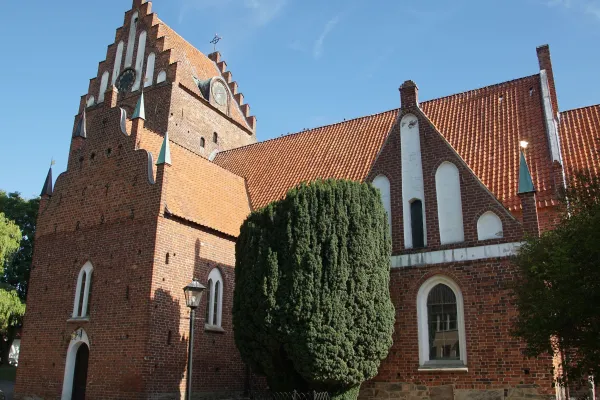
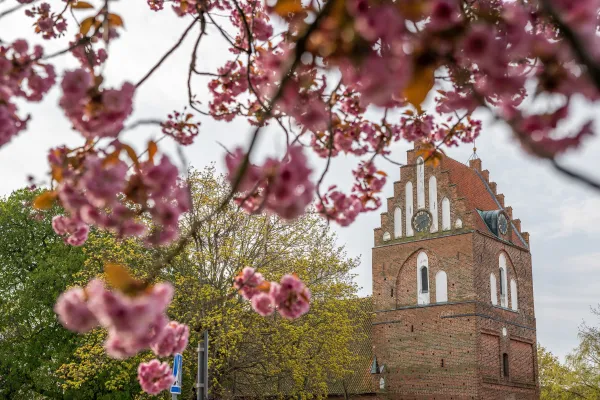
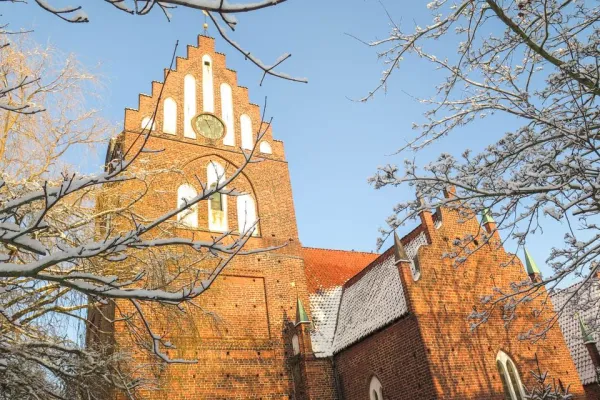
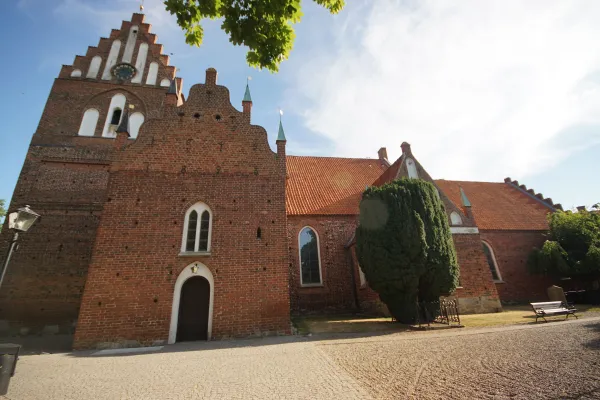
St. Nicolai Church is Sölvesborg's only preserved medieval building. "Is anciently built of brick", according to the drawing from 1820.
Beskrivning
Around the turn of the century, the oldest part, the choir, began to be built. It was probably connected to an older church: an altar slab from this is walled in the southern chapel. In its place, the nave was erected, transepts were laid out, and vaults were planned. Good times in the late 14th century gave rise to a richly decorated west tower. But the transepts became only a chapel, the baptistery and the church began to be vaulted. Shortly afterwards, the armory was built, powerful and on two floors.During the first years of the 15th century, the vaults and walls were decorated with stately - sometimes burlesque - paintings. The short ceiling tells the story of the Virgin Mary's life from the Bible. The series ends with the coronation of the Queen of Heaven framed by the full splendor of Gothic. Angels play music, the four evangelists confirm what is happening.
The armory's rigid, playing-card-like painting has the life of Christ as its theme. The church's walls are populated by saints, serious. At the same time, the triumphal crucifix is hung in place. Emaciated, bloodstained, the king of pains would separate the priest from the congregation. In the emaciated face, in the tense curve of the body, the entire blood worship and well-calculated ecstasy of Gothic art are revealed.
The altarpiece and pulpit are works of Christian IV's Renaissance, 1620s. They show an architecturally controlled lushness and joy of style; "Regna Firmat Pietas" (Piety strengthens the realm), which can be read on the pulpit, was the king's motto.
To the north of the church, destroyed buildings can be traced. Here stood a Carmelite monastery founded in 1486, which the Pope in Rome determined would be located in Sölvesborg. After 50 years, the Reformation swept away the monks and their refectory (dining room), dormitory (dormitory), herb garden and beautiful flower garden. In 1945 the remains were excavated. The finds are on display at Sölvesborg Museum.
There are two rune stones set up by the church, the Stentoften Stone in the armory and the Sölvesborg Stone outside the tower. The strangest of them, the Stentoften Stone, has a curse spell inscribed on it. See more information about the Stentoften Stone.