
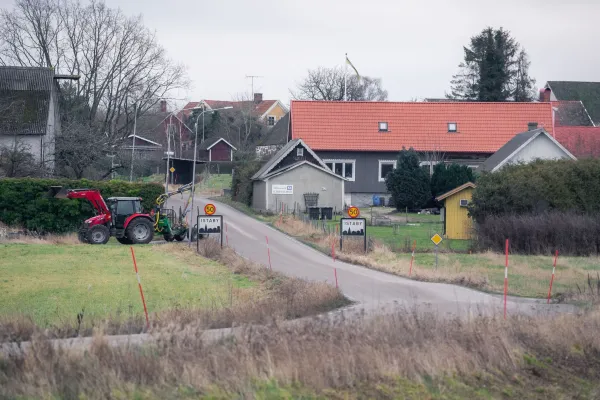
Istaby village
- Sölvesborg
- +46 456-81 61 81
- visit@solvesborg.se
- Istaby - 294 94 - Sölvesborg
-
<% getFormattedDate(occasion) %> <% setPopoverDateLabel(occasion) %>
On one of the hills of Listerlandet lies Vitaby, a legendary cluster village with many ancient finds.
Beskrivning
Istaby is one of the larger villages on Lister and the name is said to mean "The outermost village". Here you can clearly see the results of the 1826 shift, when about ten farms were forced to move out of the village. Most of them were placed along a newly built road, which ran south from the village, while a few farms were placed north of the old village site. At the time of the shift, the settlement consisted partly of rectangular farms of the Scanian type. Today it has taken on a more Gothic character, where the manor farm is separated from the cattle farm.In the 1970s, parts of an extensive prehistoric settlement and burial complex were investigated in the open fields just southeast of the village. The oldest finds belong to the Early Neolithic Age (c. 3000 BC), but the majority of the material originates from the Late Bronze Age-Early Iron Age (c. 500 BC - 200 AD). The investigation has revealed a developed farming society mainly based on agriculture and livestock farming but also with extensive trade contacts with surrounding areas. The many finds are exhibited at Blekinge Museum in Karlskrona.
Istaby was previously home to the famous runestone Istabystenen, which is today at the Historical Museum in Stockholm.
A legend also tells that the mythological queen of heaven Ishtar is buried in Istaby together with her jewels and a harp of gold.