
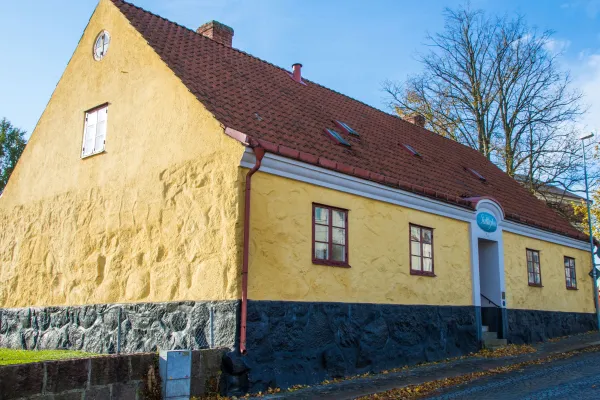
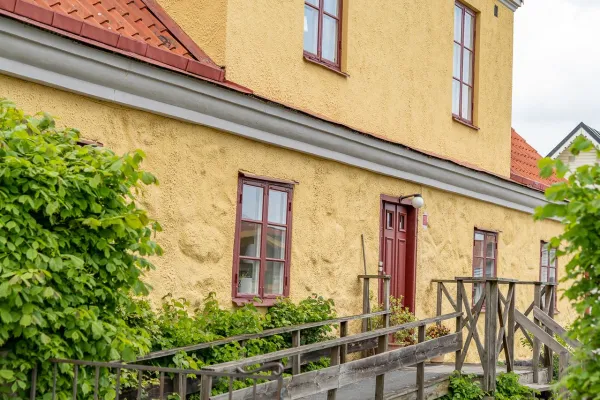
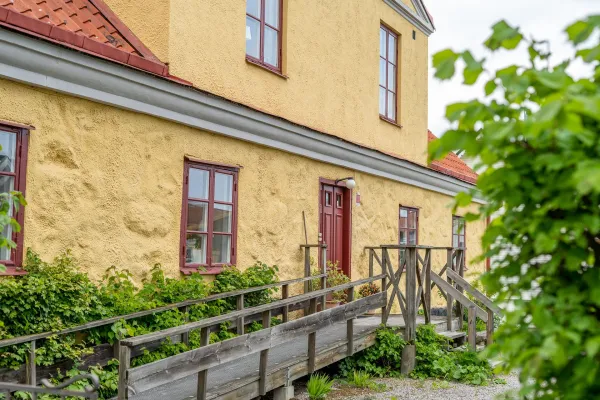
The Old Poor House - historic building
- Sölvesborg
- +46 456-81 61 81
- visit@solvesborg.se
- Västra Storgatan - 294 34 - Sölvesborg
-
<% getFormattedDate(occasion) %> <% setPopoverDateLabel(occasion) %>
The first and only poorhouse that Sölvesborg ever had was completed in 1821 and is one of the town's architectural landmarks. Today, the building is used for business purposes and is not open to visitors.
Beskrivning
The desire for a poorhouse had existed in the city since at least the 1770s, but financial means had been lacking. The need was especially great after the fire of 1801. At that time, 44 households were destroyed and 208 people were left homeless, which meant that about a third of the city's inhabitants were homeless. When King Karl XIV Johan passed through the city in 1819, he was so warmly welcomed that he donated 1,000 riksdaler to the city. The king explicitly said that the money should be used for a house for the poor.The poorhouse was built of the most durable material imaginable, grey stone. It was placed a little outside the western customs house, on the slope up towards Möllebacken, where for a long time it had no other neighbors than a mill and a small farm. In 1839, the poorhouse underwent its first repairs, which cannot have been particularly extensive, since the costs were limited to 62 riksdaler.
When the house was insured for fire in 1858, it consisted of 6 rooms, 2 kitchens and a hall. Around 30 poor people were housed here at that time. The largest group of poor people were widows and widowers together with their children. They were often craftsmen. Hat and glove makers were craft groups that had particular difficulty in earning an income during the latter part of the 19th century. Orphans, the mentally ill, and unmarried older women are other groups that have also lived in Sölvesborg's poorhouse. The orphans only lived here for a short time before being transferred out, while others could stay for up to twenty years. Widows and widowers with children usually had their own room. It often became very crowded and the two kitchens had to serve as bedrooms.
In the mid-19th century, there was still no staff at the poorhouse, so the couples had to help each other as best they could. The poor who were able to help the sickest could receive an increased weekly allowance, and most were therefore willing to help. The members of the poor board, who consisted of important and prominent men in the city, took turns visiting the poorhouse regularly. The poor board decided on the activities and who was allowed to live in the house.
The poorhouse was sparsely furnished and the furniture that was there was that which the poor had brought there themselves. Most of what the poor brought with them quickly became the property of the poorhouse, since those who expected to spend the rest of their lives in the poorhouse were obliged to bequeath their movable property there. The most common possessions that the poor brought with them to the poorhouse were a bed with accompanying bedding, a table or chair, and some linen clothes. The women often owned some textile equipment, such as a spinning wheel or a skein. Many also owned something that revealed that they had once been better off. It could be a hymn book, handkerchiefs or perhaps a mirror. In really poor times, it could happen that the poorhouse board bought clothes and furniture for the poorhouse.
The old poorhouse itself is very well preserved. The interior contains joinery, two tiled stoves, a stove, etc. preserved from the time of construction. The house is an integral part of Sölvesborg's building history and is very interesting, not least from a social historical point of view. Since 1940, the poorhouse has been used as a museum for the collections of the Sölvesborg and Lister County Historical Society. The old poorhouse was declared a listed building in 1996. The house is located within an area of national interest for cultural environment conservation: the city of Sölvesborg, whose town plan is one of the country's best-preserved examples of regular market towns from the late Middle Ages. The city grew up under the protection of Sölvesborg Castle, one of the most important Danish royal strongholds of the Middle Ages. After a city fire in 1801, the trading town was rebuilt with a still partly well-preserved small-scale settlement.
The text is taken from the County Administrative Board's website www.lansstyrelsen.se/blekinge/